Oestrogen and Your Skin: The Clinical Connection Most People Miss

If you're in your late 30s or 40s and your skin has changed, you're foggy more days than not, your hair is thinning, and your body is doing things you don't recognise, you're not imagining it. And it's very likely not your skincare routine that needs fixing.
Oestrogen is not a reproductive hormone that happens to affect a few other things on the side. It is a systems hormone, one that is active in your skin, your brain, your gut, your bones, your heart, and your metabolism, all at once. When it starts to fall in perimenopause, changes ripple across every one of those systems simultaneously. That's why the symptoms can feel so confusing and so widespread.
This post is the clinical picture I wish more women in their 40s had access to earlier. Not because it is a solution in itself, but because understanding what's actually happening is the first step toward addressing it properly.
Oestrogen is a systems hormone, not just a sex hormone
From puberty onwards, oestrogen (the primary female sex hormone, produced mainly by the ovaries) is working in your skin cells, your brain neurons, your gut lining, your bone matrix, and your fat tissue. Every one of those tissues has oestrogen receptors, which means they're designed to respond to it, and they do, continuously.
Perimenopause is the transition period in the years before the final menstrual period, typically beginning in the mid to late 40s, though for some women it starts in their late 30s. During this phase, oestrogen production does not fall in a straight line. It fluctuates, sometimes quite dramatically, before the overall trend downward becomes clear. That fluctuation is part of why the symptoms feel so unpredictable.
What I want to look at here is what falling oestrogen does to specific systems that women often don't connect to hormones until they're already struggling.

What happens to your skin
Oestrogen supports collagen (COL-ah-jen, the structural protein that keeps skin firm, thick, and smooth) production. In the first five years after oestrogen starts declining, without hormonal support, skin thickness reduces by approximately 30%. That is not a gradual, barely-perceptible process. For many women, it is visible, and it happens faster than most expect.
But collagen loss is only part of it.
Oestrogen also regulates sebum (the natural oil your skin produces) output. When oestrogen falls, some women experience dry, tight, dehydrated skin. Others find their skin is oilier or more congested than it's ever been. Some experience both at the same time, dryness on the cheeks and congestion on the chin and jawline, which makes no sense until you understand that oestrogen and androgens (male hormones, also present in women, that become more dominant as oestrogen falls) are now pulling in different directions.
Then there's the skin barrier. Oestrogen supports the production of ceramides (lipid molecules that hold the skin barrier together and lock moisture in). When ceramide production drops, the skin becomes more reactive. Products you've used for years suddenly cause redness or irritation. Healing from minor breakouts or treatments takes longer. Sensitivity increases not because your skin has changed its mind about your routine, but because the hormonal support that was underpinning it has reduced.

The deep dryness many women describe in perimenopause, the kind that no moisturiser seems to fix, comes from changes in the dermal layer (the deeper layer beneath the skin surface). This is not a surface problem. It is a structural one.
What this looks like in practice
Skin that seems to have aged faster than expected. Unexpected breakouts alongside dryness. Products causing reactions they never did before. Slower healing. More redness. None of it responds to adding more products, because the issue is not on the surface.
What happens to your hair
Oestrogen supports scalp health, follicle density, and hair thickness. One of the ways it does this is by reducing the effect of androgens at the scalp. When oestrogen falls and androgens become relatively more dominant, many women notice increased hair shedding, thinning at the temples or crown, and a general change in the texture and density of their hair.
This is not the same as female pattern hair loss, though the two can overlap. Hormonal hair thinning in perimenopause is a response to a changing hormonal environment, and it is far more common than most women are told.
What happens to your brain
This is the part that tends to surprise people most, and the part I feel most strongly should be talked about more openly.

Oestrogen supports the activity of dopamine and serotonin, the neurotransmitters (chemical messengers in the brain) that regulate mood, motivation, focus, and memory. It also has a direct neuroprotective effect, meaning it supports the health and function of brain cells over time.
When oestrogen falls, many women experience brain fog (difficulty thinking clearly, struggling to find words, poor short-term memory), low mood, anxiety that comes from nowhere, and a general sense of mental flatness. These are not psychological symptoms. They are neurological responses to falling oestrogen.
This matters because women are often told they're stressed, anxious, or depressed, and treated for those things in isolation, when the root picture is hormonal. That doesn't mean the distress is not real. It absolutely is. But the starting point for investigation should include oestrogen, not exclude it.
What happens to your metabolism
Oestrogen improves insulin sensitivity (how well the body uses glucose from food to produce energy rather than storing it as fat). It also supports the retention of lean muscle mass, and it influences where fat is stored in the body.
As oestrogen falls, several things tend to happen at once. Insulin sensitivity reduces, making it easier for glucose to be stored as fat rather than used as fuel. Lean muscle mass is harder to maintain. Fat distribution changes, with more fat accumulating around the abdomen, even without any change in diet or activity level.
This is why women often describe their body changing in their 40s despite eating and exercising exactly as they always have. It is not a willpower problem or an age problem. It is a hormonal one.
Why this matters if you're coming to the clinic for your skin
One of the things I feel strongly about as a pharmacist and aesthetics practitioner is that treating the skin without considering the hormonal context is, in many cases, managing the surface rather than the cause.
If a client comes to me in her mid-40s with skin that's thinning, congested, reactive, and not responding well to her routine, and she also mentions she's exhausted, her hair is thinner, she's not sleeping, and she feels foggy, those are not separate complaints. That is one clinical picture, and oestrogen is central to it.
That doesn't mean the answer is always hormonal treatment. There are many ways to support oestrogen's actions in the skin, and aesthetic treatments can produce excellent results. But the outcomes are better, and more sustained, when the skin is assessed as part of the whole hormonal picture, not in isolation from it.
Collagen stimulation treatments work better when the internal environment is supporting collagen production. Barrier repair works better when the skin has the building blocks it needs. Hydration treatments hold their results longer when the underlying hormonal support is not actively working against them.
Products at Debora Tentis Clinic for oestrogen-depleted skin
These are the products I use and recommend for skin that is losing firmness, barrier integrity, or resilience in perimenopause:
- AllSkin Med GF Firming Serum — growth factor firming serum for mature, sagging, or volume-depleted skin. £75.
- AllSkin Med GF Replenishing Cream — nourishing growth factor moisturiser for dry and perimenopausal skin. £70.
- PRIORI DNA fx221 Recovery Serum — recovery serum with DNA repair technology for mature and stressed skin. £99.
- SkinBetter Alto Advanced Defense and Repair Serum — antioxidant-rich defence and repair serum for daily environmental protection. £104.
The integrated approach
I've built the Happy Skin Holistic Consultation at Debora Tentis Clinic specifically because of this clinical reality. It brings together an assessment of the skin, the current hormonal picture, and the lifestyle factors that are known to affect both.
The goal is not to sell a stack of treatments. The goal is to understand what is actually going on, which systems are involved, and what the most effective starting points are, whether that's skincare, aesthetics, hormonal investigation, or all three.
If you're in your late 30s or 40s and your skin has changed in ways you can't explain, I'd encourage you to consider that the answer may not be in your bathroom cabinet.
Products and treatments at Debora Tentis Clinic
Addressing oestrogen's effect on your skin requires both systemic support and a topical foundation that your skin can actually use.
Support from the inside
Oestrogen supports collagen production, so as it falls, a real dose of collagen plus the Vitamin C your body needs to build it is a sensible internal foundation alongside your topical routine:


Food supplements. Vitamin C contributes to normal collagen formation. Not a substitute for medical advice.
The topical foundation
These are the products I recommend for skin that is losing firmness, barrier integrity, or resilience:
- AllSkin Med GF Firming Serum — growth factor firming serum for mature, sagging, or volume-depleted skin. £75.
- AllSkin Med GF Replenishing Cream — nourishing growth factor moisturiser for dry and perimenopausal skin. £70.
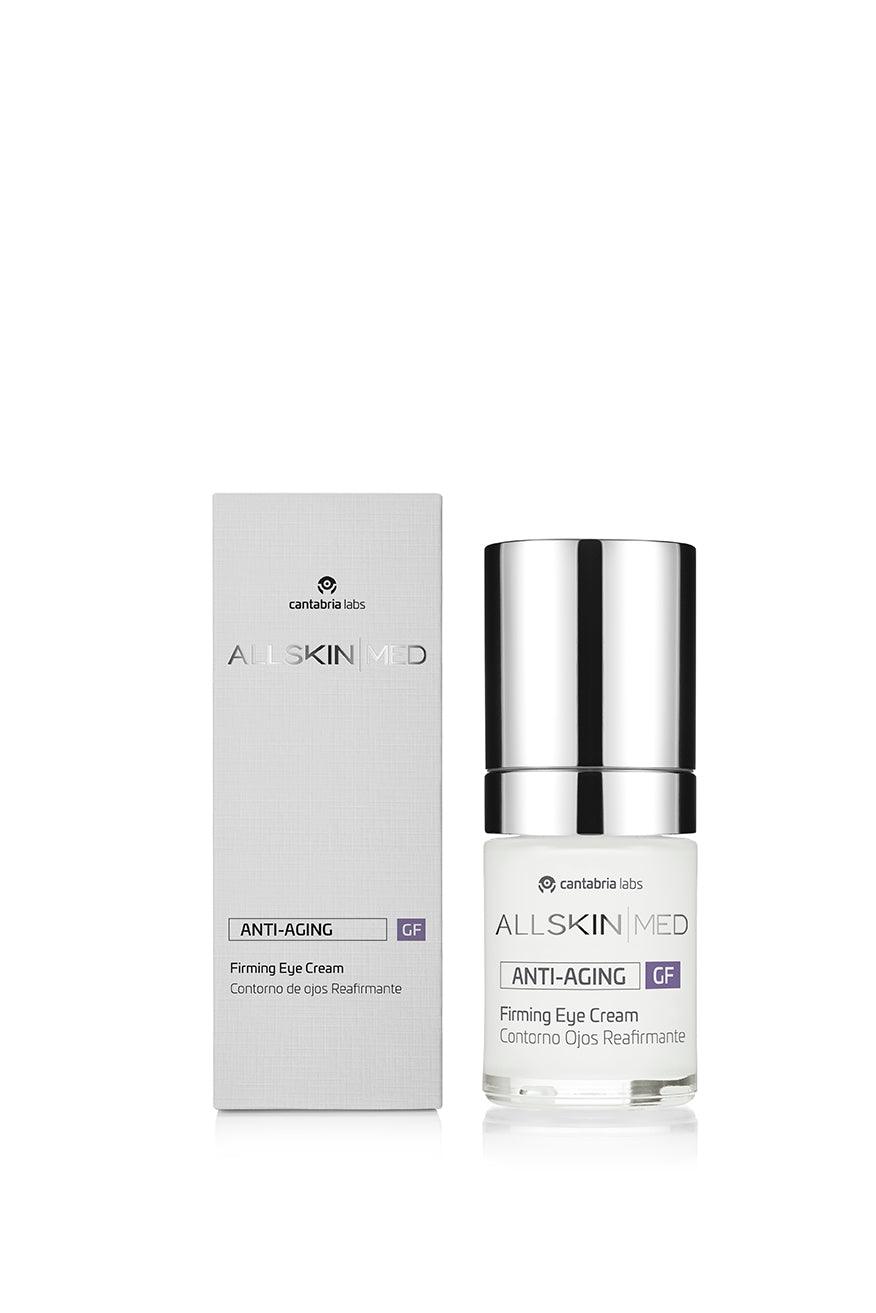
- AllSkin Med GF Firming Eye Cream — firming eye cream with growth factors for fine lines and puffiness. £50.
- PRIORI DNA fx221 Recovery Serum — recovery serum with DNA repair technology for mature and stressed skin. £99.
- SkinBetter Alto Advanced Defense and Repair Serum — antioxidant-rich defence and repair serum for daily environmental protection. £104.
- SkinBetter InterFuse Intensive Treatment LINES — intensive targeted treatment for fine lines and expression lines. £140.
- PRIORI Tetra fx251 SPF 50 — tinted mineral SPF 50 with DNA repair enzymes and blue light protection. £87.
Browse the full range at deboratentis.com. For a comprehensive skin and hormonal assessment, book a Happy Skin Holistic Consultation at Debora Tentis Clinic (£60).
Book a Happy Skin Holistic Consultation
The Happy Skin Holistic Consultation at Debora Tentis Clinic is a one-to-one assessment covering your skin concerns, your hormonal history, and how the two connect. You'll leave with a clear picture of what's driving the changes you're seeing and a plan that addresses the cause, not just the surface.
To book, visit deboratentis.com or use the booking link in the site navigation.
Debora Tentis is a Women's Health Pharmacist and Independent Prescriber Trainee based in Milton Keynes. She runs Debora Tentis Clinic, a private clinic specialising in hormonal health, metabolic optimisation, and facial aesthetics for professional women.