What Does SPF 50 Actually Mean? A Pharmacist Explains

I have had the same conversation in a consultation room more times than I can count. Someone picks up a sunscreen, checks the number on the front, puts it back down, and moves on feeling adequately prepared.
They are not adequately protected. Not even close.
The SPF number tells you one specific, limited thing about a sunscreen. What it does not tell you, and this is where most sunscreen conversations go wrong, could account for years of preventable skin ageing.
SPF Measures One Thing: UV-B Protection
SPF (sun protection factor) is calculated in a laboratory using a standardised amount of sunscreen — 2mg per cm² of skin. The number tells you how much UV-B radiation is blocked.
UV-B is the sunburn UV. It is more intense in summer, around midday, and in direct sun. Blocked by glass. The reason you turn red at a barbecue.

PRIORI Tetra fx251 Broad Spectrum SPF 50 — tinted mineral SPF with HEV shielding and DNA repair enzymes.
Here is what those numbers actually mean:
- SPF 30 blocks approximately 96.7% of UV-B
- SPF 50 blocks approximately 98% of UV-B
- SPF 100 blocks approximately 99% of UV-B (but EU and UK labelling rules cap the printed value at "SPF 50+" regardless of how high the lab result is)
The difference between SPF 30 and SPF 50 is about 1.3% more UV-B blocked. Real, but not enormous. The bigger gap is between SPF 15 and SPF 30.
PRIORI Tetra fx251 SPF 50
£87

Heliocare 360 Oil-Free Gel SPF 50
£22.50

Colorescience Mineral Sunscreen Brush SPF 50
£46
What SPF tells you nothing about is UV-A. And UV-A is the bigger long-term problem.
UV-A: The UV You Cannot Feel
UV-A (ultraviolet A radiation, the longer-wavelength band of UV radiation) makes up approximately 95% of all UV radiation that reaches your skin. It is present every day, year-round, in all weathers. It penetrates through glass and clouds. You will not feel it, it does not cause sunburn, and it does not show up as redness at the end of the day.
What it does is penetrate into the dermis, the deeper layer of your skin where collagen and elastin live, and activate enzymes (collagen-degrading proteins called matrix metalloproteinases) that break down your skin's structural scaffolding. That process happens with every UV-A exposure. It accumulates over years. It is what creates the lines, looseness, and uneven texture we associate with skin ageing.
Heliocare 360° Oil-Free Gel SPF 50 — lightweight, matte, PA++++. Ideal for oily and combination skin.
There is also strong evidence that UV-A contributes to melanoma risk and drives pigmentation conditions including melasma.
UV-A is the reason wearing sunscreen "only when it is sunny" or "only in summer" is not enough. The sun is not shining for UV-A to be doing its job.
How UV-A Protection Is Shown on UK Packaging
This is where it gets more useful.
In the UK, UV-A protection appears as a star rating: zero to five stars. The rating reflects the ratio of UV-A coverage to UV-B coverage. Five stars means the two are almost matched. That is the ideal.
The minimum to look for: SPF 50 combined with a four or five-star UV-A rating.
Colorescience Mineral Sunscreen Brush SPF 50 — brush-on SPF 50 reapplication over makeup without disturbing your base.
Some products also carry the EU broad-spectrum label, or a PA+++ or PA++++ rating (a Japanese rating system widely used on Korean and European sunscreens — PA++++ is the highest, meaning PPD of 16 or above, which is excellent UV-A protection). Any of these, combined with SPF 50, confirms genuine broad-spectrum protection.
A product labelled only with an SPF number, with no UV-A star rating or broad-spectrum label, is an incomplete recommendation.
The Application Problem Nobody Talks About
This is the part that matters most, and it almost never comes up.
The SPF value printed on the label was tested at 2mg per cm². For the average face, that works out to roughly a quarter to a third of a teaspoon, which is more product than almost anyone actually applies. Research consistently shows real-world application is 25 to 50% of the tested amount.
Here is the critical part: when you apply half the tested amount, you do not get half the SPF. You get approximately the square root of the SPF.

Heliocare 360° Mineral Tolerance Fluid SPF 50 — fragrance-free, mineral-only SPF for sensitive and reactive skin.
SPF 50, applied at half the tested amount, delivers roughly SPF 7.
That is the effective protection most people are getting. Not SPF 50. SPF 7.
The fix is simple, though it takes some adjustment: apply more than feels comfortable. A practical guide is the two-finger rule — two strips of sunscreen running from the base to the tip of your index and middle fingers held together. That is approximately the right amount for face and neck. It will feel like a lot. That is correct.
Does Sunscreen Actually Prevent Skin Ageing?
Yes. And the evidence for it is more robust than for any other skincare ingredient.
The Nambour Skin Cancer Study, published in the Annals of Internal Medicine, followed participants for over a decade. Those who applied sunscreen to their head, neck, and hands every morning had measurably younger-looking skin than those who used it whenever they felt like it. The difference was confirmed on objective photographic and clinical assessment. It was not marginal.
No retinol, no vitamin C, no peptide serum has a randomised controlled trial of that scale and duration behind its anti-ageing claims. Sunscreen does. It is, by the evidence hierarchy, the most justified anti-ageing step in any skincare routine.
What to Look for When Choosing an SPF
- SPF 50 minimum for daily face use
- Four or five UV-A stars, or broad-spectrum label, or PA++++ rating
- A texture you will actually use every day — compliance matters more than any technical specification. The best SPF is the one you apply consistently at the right amount
- Mineral or chemical depending on your skin type — more on this in a separate post; both can be excellent when chosen for the right skin
Products I stock at Debora Tentis Clinic that meet these criteria:
- PRIORI Tetra fx251 SPF 50 — mineral, tinted, with additional high-energy visible light (HEV, or blue light) protection and DNA repair enzymes. Very elegant texture. £87.
- Heliocare 360° Oil-Free Gel SPF 50 — lightweight mattifying gel, PA++++, excellent for oily and combination skin. £22.50.
- Heliocare 360° Mineral Tolerance Fluid SPF 50 — mineral-only filters, fragrance-free, PA++++. For sensitive and reactive skin. £23.50.
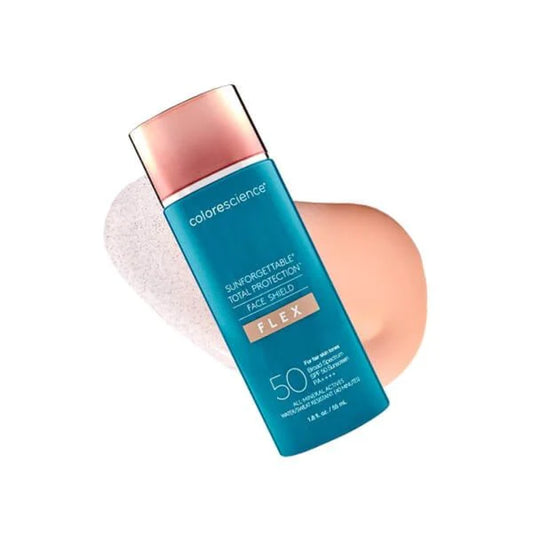
- Colorescience Sunforgettable Total Protection Face Shield SPF 50 — mineral, broad-spectrum, with UV-A, UV-B, blue light (HEV), pollution, and infrared protection. A very complete daily formula. £39.
- Colorescience Sunforgettable Mineral Sunscreen Brush SPF 50 — the easiest reapplication tool for over makeup. A brush-on mineral powder that adds SPF coverage mid-day without disturbing your base. £46.
The number on the front of the bottle is only the beginning of the conversation. UV-A coverage, how much you apply, and whether you do it every single day are what determine how much your skin actually ages. The maths is unambiguous. The habit is the hard part.
If you want help building a sun protection routine that works for your specific skin type, my skin and skincare consultation at Debora Tentis Clinic covers exactly this.
Shop the Products in This Post
PRIORI Tetra fx251 SPF 50
£87
Heliocare 360 Oil-Free Gel SPF 50
£22.50
Heliocare 360 Mineral Tolerance Fluid SPF 50
£23.50

Colorescience Face Shield SPF 50
£39
Colorescience Mineral Sunscreen Brush SPF 50
£46
Debora Tentis is a Women's Health Pharmacist and Independent Prescriber Trainee based in Milton Keynes, practising at Debora Tentis Clinic. This content is educational and does not constitute personalised medical advice.
deboratentis.com | Instagram: @deboratentis